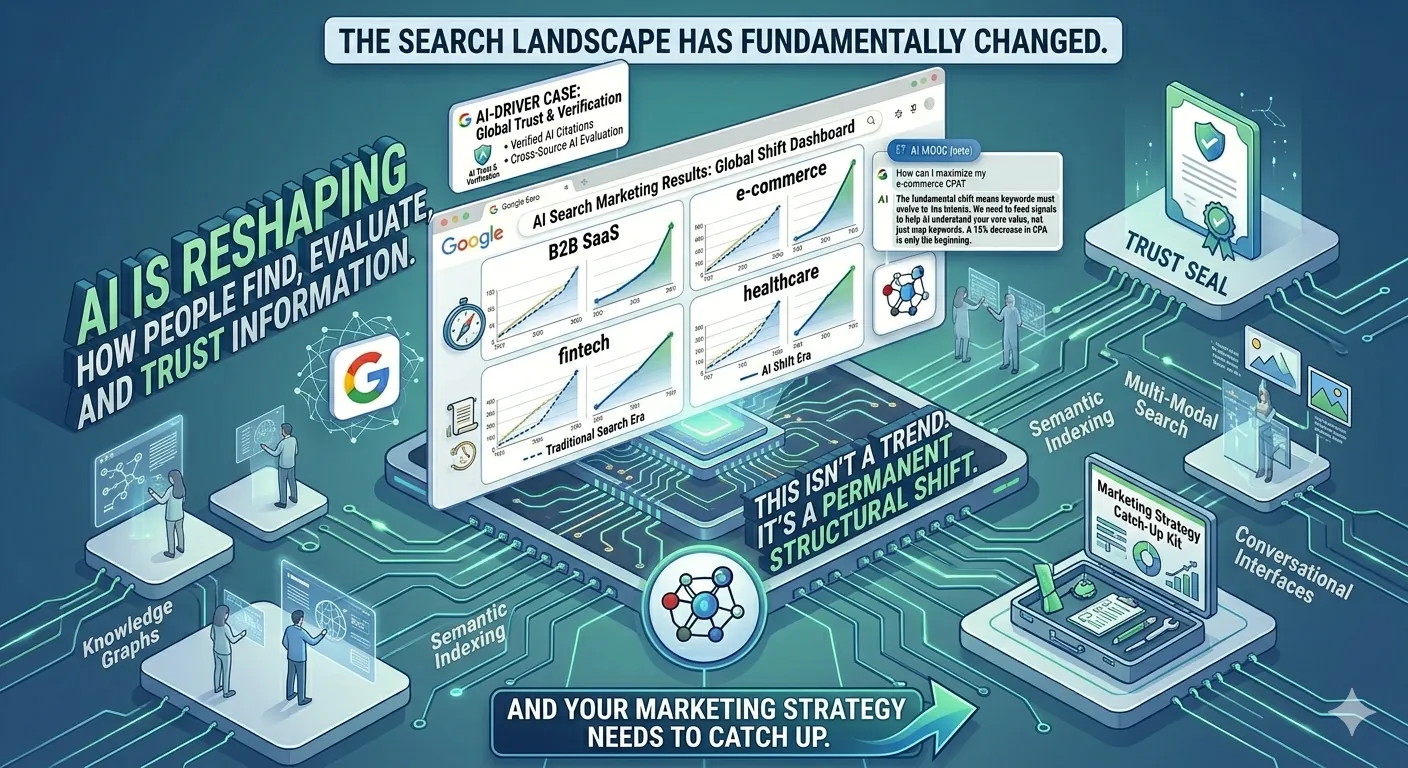
AI is reshaping how people find, evaluate, and trust information. This isn't a trend. It's a permanent structural shift — and your marketing strategy needs to catch up.
These aren't projections. This is the search landscape as it exists today — and it is changing faster than most marketing teams have realised.
As of Q1 2026, nearly half of all Google search results pages now include an AI-generated Overview at the top — pushing traditional organic results further down and often eliminating clicks for purely informational queries.
Over one billion people use ChatGPT weekly as of 2026. A meaningful and growing proportion of those interactions involve asking the AI to recommend products, services, companies, and solutions — queries that used to go directly to Google.
Nearly 4 in 10 B2B buyers now use AI assistants as part of their vendor evaluation process — querying ChatGPT or Perplexity for software recommendations before they ever run a Google search or fill out a contact form.
Among younger consumers, AI assistants are increasingly the first port of call for information — with Google consulted only for validation, or not at all. The habit formation happening now will define search behaviour for a generation.
Google AI Overviews, ChatGPT, Gemini, Perplexity, Claude, Copilot, Meta AI, Apple Intelligence, and more — there are now over a dozen distinct AI-powered surfaces where your brand can appear or be absent. Traditional SEO addresses none of them.
AI search authority compounds — brands that establish citation presence early are structurally harder to displace as models are retrained and updated. The window to be an early mover is narrowing. Brands that act in 2026 will have a fundamental advantage in 2028.
Users type a keyword into Google and scan 10 results — your brand competes for attention against 9 others on a list.
Success means ranking #1 or #2 for target keywords — positions that can be bought by competitors with higher domain authority or larger link-building budgets.
Users make their own decisions about which result to trust — your brand has no voice in that evaluation until they click.
Every optimisation targets Google's algorithm specifically — work that may not translate to AI search surfaces at all.
Content is written for keywords, not for genuine expertise — a strategy that worked in 2018 but is increasingly penalised by modern quality systems.
A user asks an AI assistant for a recommendation — and the AI recommends your brand by name, with context, as the trusted authority in your category.
Citations are earned through genuine authority signals — entity strength, content depth, citation density — that are significantly harder to manufacture or outbid.
The AI frames your brand's positioning for the user — turning your entity authority into a brand impression before they've ever visited your site.
The same authority signals that drive AI citations also improve traditional SEO — so GEO investment lifts organic performance across both channels simultaneously.
Content is engineered for genuine expertise and AI extractability — a strategy that improves with time and is resistant to algorithm changes because it reflects actual quality.
Understanding what drives AI citations is the foundation of GEO. Here's the simplified version of how the major systems work.
Large language models are trained on vast corpora of web text. Sources that appear frequently, are cited by other authoritative sources, and are consistently accurate carry more weight — meaning entity authority built over time directly influences how AI models "know" your brand.
Many modern AI systems (including Perplexity and Google's AI Overviews) use RAG — pulling current web content at query time and synthesising answers from it. For these systems, traditional crawlability, content structure, and E-E-A-T signals are directly relevant to citation inclusion.
AI models build an understanding of named entities — brands, people, organisations — based on the consistency and frequency of their representation across training data. A well-defined entity (clear Wikidata entry, consistent structured data, unambiguous NAP data) is cited more reliably and accurately.
For sensitive categories (health, finance, legal), AI systems apply additional trust filtering before citing a source. This is why E-E-A-T signals — Experience, Expertise, Authoritativeness, Trustworthiness — are disproportionately important for brands in these spaces.
AI systems prefer content that is easy to extract and reproduce accurately: concise definitional statements, structured formats, numbered lists, and explicitly attributed claims. Content written with these structures in mind is disproportionately likely to be included in AI-generated answers.
For RAG-based systems and regularly updated AI models, content recency matters. Regularly updated, authoritative content that reflects current information is preferred over outdated content — even if the outdated content previously held high authority.
We monitor and optimise for 12+ AI search surfaces simultaneously. Here are the six that currently drive the most brand discovery traffic.
Appears on 46% of Google searches, immediately above organic results. Uses RAG from Google's index combined with Knowledge Graph data. Heavily weighted toward E-E-A-T signals and structured content.
1B+ weekly users. Training-data-based for most queries, with real-time web search for recent events. Brand citations heavily influenced by entity authority and the density of authoritative sources that reference your brand.
Primarily RAG-based, pulling current web content for every query. Citations are highly trackable — Perplexity shows its sources explicitly. Strong weighting toward authoritative publications and well-structured content.
Deeply integrated with Google's Knowledge Graph and Search Console data. Entity authority established through traditional Google signals carries directly into Gemini citations — making it the most accessible AI engine for well-optimised brands.
Anthropic's model, increasingly used for professional and B2B research. Training-data-based with a conservative approach to citations in sensitive categories. Authority signals from high-trust publications carry significant weight.
Integrated across Microsoft 365, Windows, and Bing. Powered by OpenAI models with Bing search integration. Significant enterprise reach — particularly relevant for B2B brands whose buyers operate in the Microsoft ecosystem.
AI search authority doesn't reset. Brands that establish citation presence and entity authority early create compounding advantages that are structurally difficult for later entrants to overcome — for the same reason that Wikipedia pages written in 2006 still outrank competitors started in 2020.
Every month a competitor invests in GEO and you don't, they earn citations you could have had. Every AI model retrained on data that includes their citations but not yours makes the gap harder to close. The window to be an early mover in AI search is 2025–2027. After that, the category leaders will be established.
Each AI citation your brand earns increases the likelihood of future citations — because AI models trained on data that includes citations of your brand learn to associate your brand with authority in your category. The rich get richer.
Unlike paid advertising that stops the moment spend stops, content authority and entity recognition persist. A brand that has invested 18 months in semantic SEO and GEO has built an asset that continues generating returns for years — regardless of algorithm changes.
In every B2B and B2C category, AI models are forming their understanding of which brands are authoritative, which are emerging, and which don't exist. The brands shaping that understanding in 2026 will be the default recommendations in 2028.
Traditional SEO still matters — but it no longer captures the full search landscape. Brands that invest only in traditional SEO are optimising for ~54% of search queries and ignoring the 46% that now involve AI-generated answers. That gap will only grow.