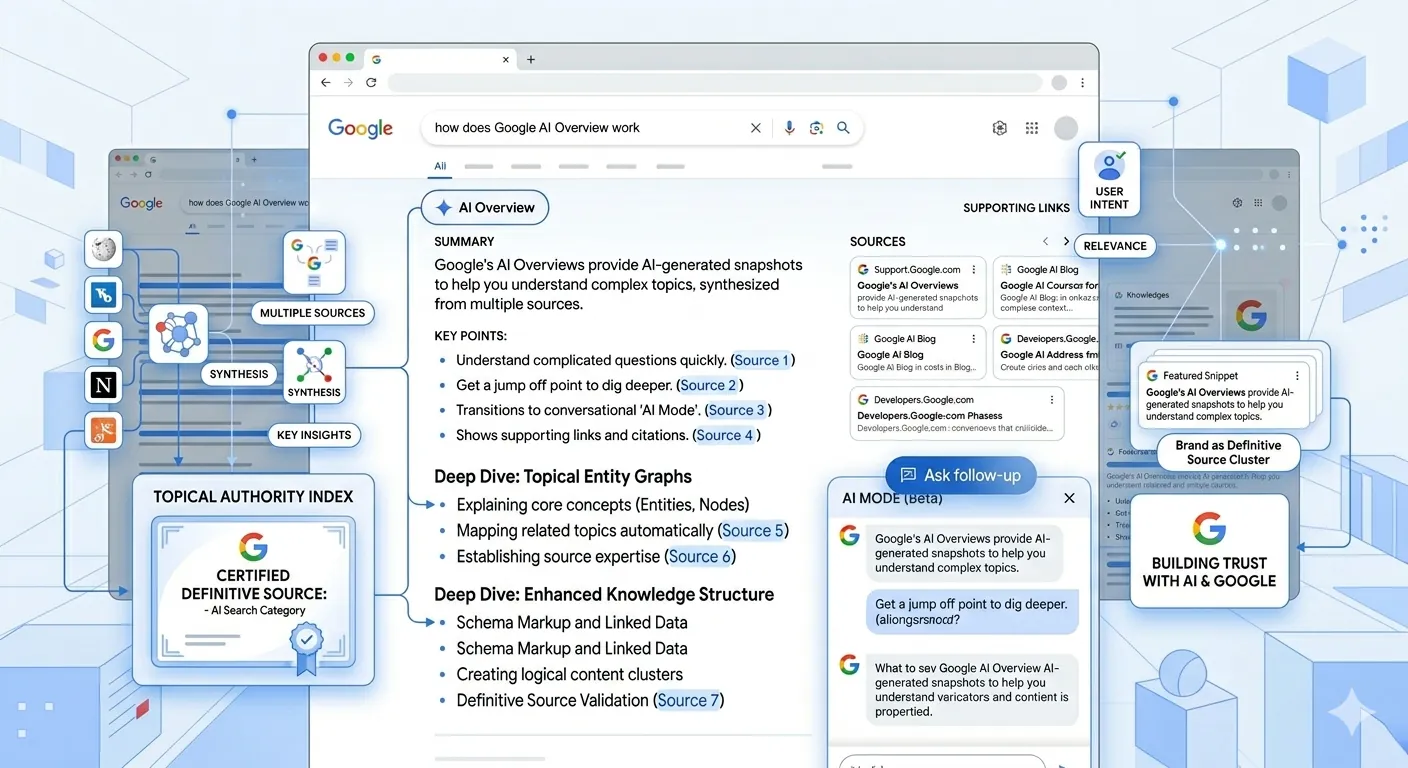
Build the topical authority that makes both Google and AI engines trust your brand as the definitive source in your category.
Google and AI engines no longer rank keywords — they rank topical authority. Semantic SEO is the architecture behind that authority: building interconnected content clusters, establishing entity relationships, and creating the depth of coverage that signals genuine expertise to every algorithm that matters.
This is the foundation every other service builds on. You can't reliably get cited in AI answers, featured in AI Overviews, or trusted by Google's quality systems without the kind of comprehensive topical coverage that semantic SEO creates.
We reverse-engineer the full topic landscape of your category — every sub-topic, related entity, question cluster, and user intent — and build a coverage plan that leaves no gap for competitors to fill.
Strategic content silos with clear internal linking architecture — pillar pages establishing broad authority, cluster pages building depth, all interconnected to maximise topical signal flow to your most important pages.
Our editorial team, supported by real subject-matter experts, produces content that passes E-E-A-T scrutiny: cited, accurate, genuinely useful, and differentiated from the AI-generated commodity content flooding every category.
We define and reinforce your brand entity across Wikidata, Google's Knowledge Panel, industry databases, and structured data — making your brand unambiguous and authoritative to every algorithm that processes it.
A systematic internal linking strategy that directs PageRank and topical relevance signals from your strongest pages to your target pages — amplifying the authority your content earns from external sources.
Bi-monthly analysis identifying topics your competitors rank for that you don't — prioritized by traffic potential, conversion intent, and authority acquisition difficulty — so we always attack the highest-value gaps first.
Full topic universe mapping, keyword clustering, entity identification, and content architecture blueprint — the strategic foundation everything else is built on.
Publication of cornerstone pillar pages — the authoritative, comprehensive resources that define your topical ownership and signal to Google that you're a serious authority in your space.
Systematic cluster content production filling every sub-topic and long-tail intent — building the depth Google rewards and the comprehensiveness that AI models require to trust you as a citation source.
Content refreshes, new cluster launches, gap analysis, and competitive monitoring — maintaining and growing your authority position as competition evolves and search trends shift.
The median organic traffic growth across all SIGNAL semantic SEO engagements over a 12-month period, measured against pre-engagement baselines.
Most clients see Google recognising their topical authority within 8 months — evidenced by ranking improvements across their full topic cluster, not just individual keywords.
The average SIGNAL semantic SEO engagement produces 60+ content assets — pillar pages, cluster content, entity pages, and supporting resources — in the first 12 months.
"We had a blog with 40 posts and rankings for maybe 200 keywords. SIGNAL rebuilt our entire content architecture and we now rank for 4,800 keywords. The leads from organic have tripled."Marketing Director, B2B SaaS Company
If your site has fewer than 50 pages of quality content, you're operating with a structural disadvantage against any competitor who has invested in topical depth. Semantic SEO closes that gap systematically.
In saturated markets, surface-level content no longer ranks. The brands that win are those with comprehensive coverage of every angle, question, and use case in their space.
Early-stage companies that invest in semantic SEO are building an organic moat that compounds for years. Those that don't are permanently paying for traffic that their competitors earn for free.
Category pages, buying guides, comparison content, and use-case pages — semantic SEO turns your product catalogue into a content ecosystem that captures every stage of the purchase journey.
Software with nuanced value propositions needs content that covers every job-to-be-done, every alternative, and every integration scenario your customers might search for.
If your rankings have declined despite technical health being solid, the cause is almost always topical authority — either you haven't built enough or a competitor has outpaced you. Semantic SEO is the fix.